The Rise of the Digital Trustee

For the past decade, businesses have been told to “digitally transform”.
Most did.
They migrated to the cloud.
They modernised applications.
They invested in data platforms.
And yet, something hasn’t improved.
Complexity has increased.
Costs are harder to predict.
Risk is less visible, not more.
The problem isn’t transformation.
It’s governance.
From ownership to orchestration
Historically, organisations owned their systems.
Infrastructure was fixed.
Workloads were predictable.
Costs were relatively stable.
That model no longer exists.
Today’s enterprise operates across:
- multi-cloud platforms
- distributed architectures
- dynamic consumption models
Nothing is static.
Everything is variable.
And increasingly, everything is interconnected.
The system is now too complex to “manage”
In a static world, management works.
You define controls.
You monitor performance.
You optimise over time.
But in a dynamic system:
- costs fluctuate in real time
- risks emerge from configuration, not just threats
- performance depends on interactions between systems, not individual components
You cannot manage this with periodic reviews and static governance models.
You need something else.
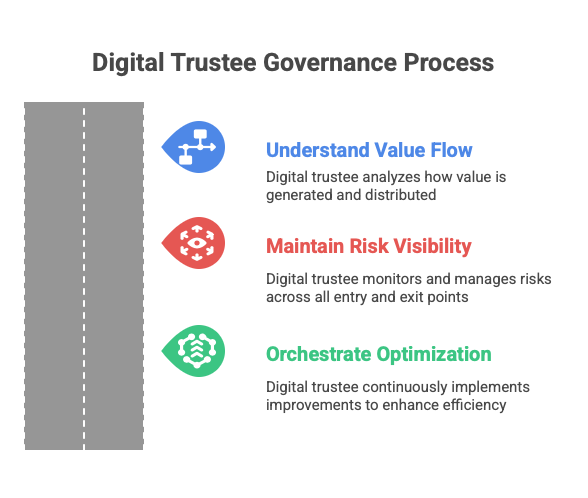
Enter the Digital Trustee
A digital trustee does not “run IT”.
They govern the system as a whole.
That means:
- understanding how value flows through infrastructure, applications, and data
- maintaining visibility of risk across every ingress and egress point
- orchestrating optimisation continuously, not periodically
This is not an operational role.
It is a strategic one.
Energy was the first system to break
Recently, parts of the energy market experienced periods where electricity had no cost.
In some cases, the system was effectively paying consumers to use it.
This wasn’t an anomaly.
It was the result of a system becoming:
- highly distributed
- highly dynamic
- and heavily influenced by real-time conditions
Energy has moved from:
- predictable supply and demand
to: - real-time optimisation and orchestration
IT is following the same path.
The same pattern is emerging in technology
We are now seeing:
- compute costs fluctuating with demand and availability
- AI workloads introducing unpredictable consumption patterns
- security risks driven more by misconfiguration than intrusion
The implication is clear.
The challenge is no longer building systems.
It is governing them.
Visibility is the new control plane
You cannot control what you cannot see.
In complex environments, risk is not just external.
It sits in:
- firewall configurations
- network policies
- unused or conflicting rules
- poorly understood dependencies
Similarly, cost is not just a billing issue.
It is a function of:
- when workloads run
- where they run
- and how they interact with the wider system
Without visibility, optimisation is guesswork.
Optimisation is now continuous
In static environments, optimisation was periodic.
Quarterly reviews.
Annual cost reduction programmes.
In dynamic systems, optimisation must be continuous.
This requires:
- real-time data
- automated analysis
- and the ability to act quickly
The organisations that succeed will not be those that reduce cost once.
They will be those that continuously capture value from volatility.
The shift organisations are not yet making
Most organisations still operate with:
- static governance models
- fragmented visibility
- reactive decision-making
They are trying to apply old thinking to a fundamentally new system.
This creates a gap.
Not in technology.
But in capability.
From delivery to trusteeship
The next phase of digital maturity is not about building more.
It is about governing better.
This is where the role of the digital trustee emerges.
Not as a vendor.
Not as a delivery partner.
But as a strategic custodian of complex, dynamic systems.
The question that matters
The question is no longer:
“Have we transformed?”
It is:
“Do we understand and control the system we’ve built?”
Because if you don’t, you are not optimising it.
And if you are not optimising it, someone else will capture that value.
The organisations that recognise this shift early will have an advantage.
The rest will continue to operate in systems they no longer fully understand.