
The Day Energy Had No Cost

There are rare moments when energy markets reveal something deeper than price. Today was one of those days.
For a stretch of hours, electricity did not just become cheap. It became effectively free. In some periods, prices even turned negative. The system was paying consumers to take energy.
At first glance, that feels broken. In reality, it is a sign that something is working exactly as intended, just not in a way our systems are ready for.
When the Grid Has Too Much Power
Today’s conditions were unusual, but not unimaginable.
Strong winds driven by Storm Dave pushed wind generation high. At the same time, clear skies boosted solar output. Then demand dropped away as a bank holiday reduced commercial and industrial activity.
High supply met low demand.
Electricity has to be balanced in real time. When there is too much of it, the system has limited options. It can turn generators down, export if capacity allows, or let prices fall until demand increases.
Today, prices did the work.
The Paradox of Abundance
For most of the last century, energy has been defined by scarcity. Everything about the system reflects that assumption. Infrastructure, pricing, behaviour.
But today showed something different.
We had moments where:
- Electricity was effectively free
- Consumers could be paid to charge EVs
- Solar generators exported power for little or no return
- Clean energy risked being curtailed despite perfect conditions
This is not a failure of renewables. It is what happens when zero marginal cost generation meets a system designed for scarcity.
The Paradox Next Door
Consider two houses on the same street.
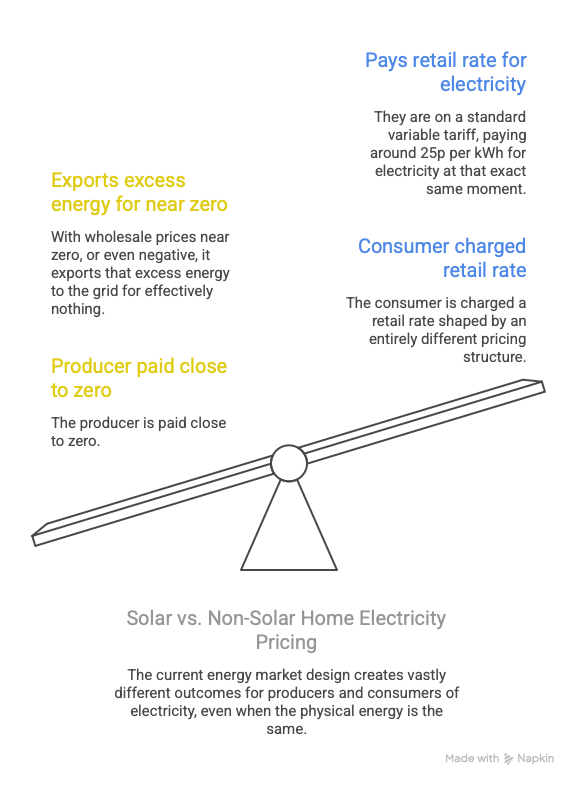
House A has rooftop solar. At midday, it is generating more electricity than it can use. With wholesale prices near zero, or even negative, it exports that excess energy to the grid for effectively nothing.
House B, right next door, does not have solar. They are on a standard variable tariff, paying around 25p per kWh for electricity at that exact same moment.
The electrons are indistinguishable. In physical terms, there is a strong chance that the energy flowing out of House A is being consumed by House B just metres away.
And yet the outcome is completely different.
The producer is paid close to zero.
The consumer is charged a retail rate shaped by an entirely different pricing structure.
This is not a failure of physics. It is a mismatch between how the system operates and how the market is designed.
Retail pricing is still largely:
- Smoothed over time
- Insulated from real-time wholesale volatility
- Built for a world where energy was scarce and predictable
That world is changing.
Zero Cost Generation Meets Inflexible Demand
Wind and solar have changed the fundamentals.
Once built, they produce electricity at near zero marginal cost. They generate when the weather allows, not when the market asks them to.
This creates periods of abundance that the system struggles to absorb.
The problem is no longer how to generate energy. It is what to do with it when it arrives.
Without flexibility, the system has to:
- Push prices down
- Waste energy through curtailment
- Or export value elsewhere
Who Benefits from This Shift
The dividing line is no longer generation. It is flexibility.
Those who can respond to price signals benefit:
- EV owners charging at the right time
- Homes with batteries
- Businesses with flexible demand
- Platforms orchestrating consumption
Those who cannot respond are left behind:
- Households on static tariffs
- Generators without storage or optimisation
- Systems that cannot shift load
Value is moving away from simply producing energy. It is moving toward using it intelligently.
From Scarcity to Coordination
This is the deeper shift underway.
We are moving from a system built around scarcity to one defined by abundance at specific moments in time.
That changes everything.
Energy is no longer just about how much you use. It is about when you use it.
A unit of electricity at 6pm is not the same as one at 2pm on a windy, sunny bank holiday.
The system needs to evolve to reflect that reality:
- More dynamic pricing
- Smarter automation
- Better signals to consumers
- Infrastructure that can store and shift energy
Rethinking the Value of Energy
If energy can be free, what does that mean for its value?
It means value is no longer embedded purely in the unit of energy itself.
It sits in:
- Timing
- Flexibility
- Location
- Control
The ability to align demand with supply is becoming more valuable than the act of generation alone.
The Day Energy Had No Cost
Today was shaped by Storm Dave, strong solar output, and suppressed demand. But those conditions will not remain rare.
They are becoming a feature of a renewable system.
Energy did not lose its value today.
It showed us where value is moving.
Away from production.
Toward coordination.
Toward intelligence.
The real question is no longer how we generate enough energy.
It is whether we can learn to use it when it matters most.