The Paradigm Shift in Who Manages Energy Risk

Why dynamic tariffs are quietly changing how energy price risk is managed in the UK electricity system
Editor’s Note
This article reflects LDS Consulting’s perspective on emerging trends in UK electricity markets and the growing role of dynamic pricing. As renewable generation increases and pricing becomes more responsive to real time system conditions, consumers and businesses are beginning to see market signals that were previously hidden behind traditional tariffs.
Understanding these signals and how they influence the value of electricity at different times of day will become increasingly important for organisations managing energy costs and flexibility.
Energy headlines and market reality
Over the past week energy headlines have once again been dominated by geopolitical tension. Escalating conflict involving Iran has prompted warnings that global oil and gas markets could face disruption, with the familiar suggestion that higher energy prices may soon follow.
If you listened only to the headlines you might assume those pressures had already begun flowing directly into the domestic energy market.
But the reality visible on dynamic electricity tariffs tells a more nuanced story.
For households and businesses observing half hourly electricity pricing through tariffs such as Agile, recent weeks have actually produced periods of unusually cheap electricity imports. Strong wind generation and increasing solar output have pushed wholesale electricity prices down during parts of the day, even while global fuel markets remain volatile.
In other words while geopolitical risk continues to influence the global energy narrative, the UK electricity system is increasingly being shaped by something much closer to home. The weather.
And that shift raises a much larger question within the UK energy system.
Who is now responsible for managing energy price risk?
What the market looks like in practice
A look at a single day of Agile export activity from a domestic meter provides a useful illustration of how these dynamics are now playing out in real time.
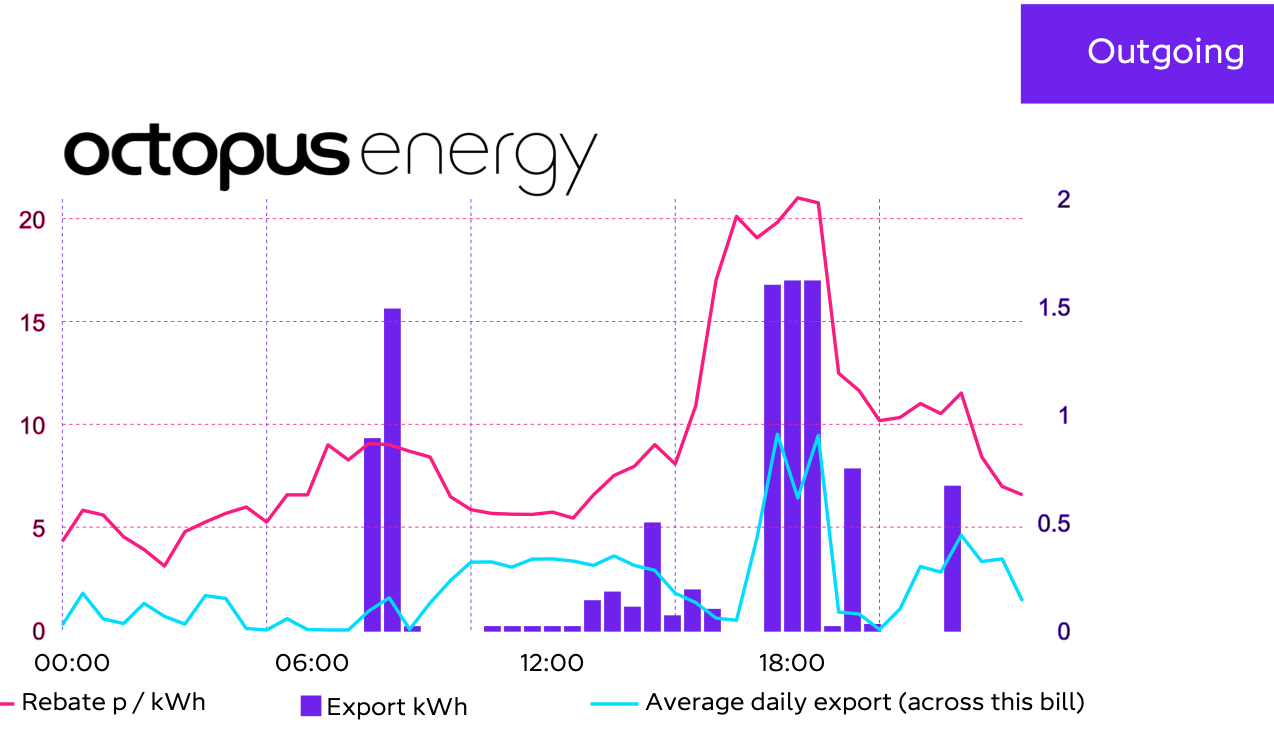
Chart caption
Half hourly Agile export pricing and generation from a domestic solar installation. As solar output declines later in the day and demand increases across the electricity system, market prices rise. For consumers importing electricity this represents higher costs, while for microgenerators exporting electricity the same period becomes more valuable.
What stands out is not simply that prices move, but when they move.
Earlier in the day when solar generation is stronger and electricity supply across the system is relatively abundant, prices are lower. As the day progresses and solar output begins to fall, wind generation may soften and system demand increases into the evening peak. Prices rise accordingly.
That has two very different consequences depending on which side of the meter you are on.
For customers importing electricity from the grid those periods become more expensive. For microgenerators exporting electricity those same periods become more valuable.
This is the significance of dynamic pricing. Electricity is not worth the same amount at all times of day. Its value changes depending on the balance of supply, demand and generation on the system.
While this single day provides a snapshot, the wider market over recent weeks has been even more volatile.
For most of the history of the electricity market consumers never saw these movements. Dynamic tariffs have simply made them visible.
The old model
For decades the structure of the UK energy market meant that most consumers did not need to think about wholesale market volatility.
Energy suppliers purchased electricity and gas in advance, hedging price fluctuations in the wholesale market and offering tariffs that smoothed out those movements for households and businesses.
Consumers paid predictable rates while the complexity of wholesale markets remained largely invisible.
That model was already under pressure before the energy crisis of 2022.
Russia’s invasion of Ukraine exposed just how fragile the system had become. As wholesale gas prices surged many suppliers were unable to absorb the scale of volatility.
Government intervention through the energy price cap and wider support mechanisms effectively spread the financial impact across society. The cost of stabilising the market did not disappear. It was redistributed and will ultimately be recovered through future bills and taxation.
In effect the responsibility for managing energy price risk had already begun shifting away from suppliers.
Dynamic tariffs extend that shift
Now with the emergence of dynamic tariffs such as Agile that shift appears to be moving even further.
These tariffs were available well before the Ukraine crisis, but their significance within the energy system is increasing.
Rather than smoothing wholesale volatility dynamic tariffs expose consumers directly to real market prices for electricity. Prices rise and fall throughout the day depending on demand, renewable generation and system conditions.
What used to be managed through financial hedging by suppliers is gradually being replaced by decisions made by consumers about when energy is used, stored or exported.
In simple terms households and businesses are increasingly being rewarded for paying attention to the price of energy and adjusting their behaviour accordingly.
Energy is a commodity. We should treat it like one
This shift can feel unfamiliar because for decades electricity has been framed as a basic service rather than a traded commodity.
But electricity has always been a commodity. The difference today is that technology is finally allowing consumers to see its price change in real time.
Once those price signals become visible behaviour naturally begins to change.
Most people would not rush to buy gold at the exact moment its price was peaking if they knew it would fall the following day. Equally few travellers would deliberately buy foreign currency at an unfavourable exchange rate if they knew it was about to improve before their flight.
Yet historically that is exactly how electricity has been consumed.
Energy has been used whenever required at a flat tariff largely disconnected from the real cost of producing it at that moment.
Dynamic tariffs challenge that mindset.
They expose a simple reality that the electricity system has always understood.
The value of energy changes constantly.
Opportunity and volatility
Access to real time pricing creates both opportunity and volatility.
Periods of strong renewable generation can produce very cheap electricity during parts of the day. As solar output falls, wind generation changes and demand increases into the evening peak, prices can increase sharply.
At those moments electricity becomes more expensive to import and more valuable to export.
Agile tariffs can therefore reveal some of the cheapest electricity available in the market while also exposing consumers to some of the most expensive hours if consumption is not managed carefully.
For households and businesses that can respond to those signals by shifting demand, charging vehicles overnight or storing energy when it is abundant the opportunities can be significant.
For others the volatility may require a different approach to energy management.
A different relationship with energy
If consumers are increasingly participating in the market then the conversation around energy also needs to change.
Energy should increasingly be treated as something that is
understood
measured
actively managed
For households this may mean paying attention to pricing patterns or investing in technologies that allow energy consumption to shift automatically.
For businesses it may mean integrating energy strategy into operational decision making in the same way that other commodity costs are managed.
Electricity is no longer simply a background utility. It is becoming a dynamic market signal.
Those who understand it will increasingly benefit from it.
A structural shift in the energy system
This shift may still feel subtle today, but it represents a profound change in how the electricity system operates.
Electricity is no longer simply a background service delivered at a flat rate. It is increasingly a commodity whose value moves throughout the day, shaped by weather, demand and the structure of the grid.
For households and businesses willing to pay attention that creates opportunity. For the energy system as a whole it creates flexibility.
But it also means something else.
The future of energy will not just be defined by how electricity is generated.
It will be shaped by how intelligently it is consumed.
Electricity is becoming cheaper when it is abundant and more expensive when it is scarce.
The real question now is not simply how much energy we use.
It is whether we are paying attention to when we use it.